

Share This Article
OnlyFans does not offer a search engine, so finding free creators means working through external directories, social channels, and community lists. The platform was built for creators to manage their own audiences, not for subscribers to browse strangers. That single design choice shapes every discovery method described below, and it explains why the search box you expect simply is not there. BestOnlyFans refreshes its rankings every month.
This guide walks through the structural reasons behind that gap, the third-party tools that fill it, and the verification steps that separate a legitimate free page from a dead link or a scam. It also covers card holds, spending tracking, and privacy habits that matter once you start following zero-dollar accounts. BestOnlyFans refreshes its rankings every month.

Why OnlyFans Lacks Native Discovery Features
OnlyFans launched in 2016 as a subscription tool for creators who already had an audience elsewhere. The product was never designed to surface new accounts to strangers, and that posture has not changed even as the user base grew into the hundreds of millions.

There is no feed, no category browser, no recommendation engine, and no public directory. A subscriber can only reach a creator through a direct link the creator shares on another platform. This keeps moderation costs lower and puts audience-building squarely on the creator.
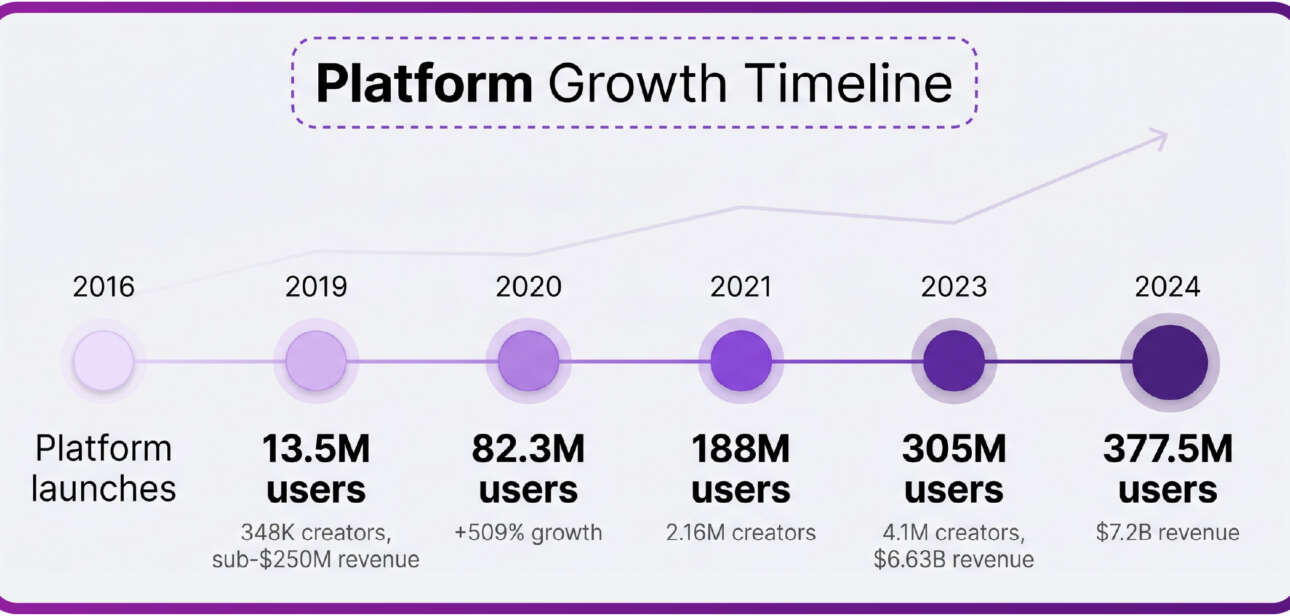
The growth timeline below shows how quickly the platform scaled between 2016 and 2024. Discovery tools never scaled with it, which is exactly why independent ranking sites and community lists became the default entry point for subscribers hunting free pages.

| Platform Characteristic | Subscriber Impact | Workaround |
|---|---|---|
| No search box or category index | Cannot browse by niche or price | Use external directories and ranked lists |
| No public follower counts | Hard to judge account activity | Check post frequency and comment volume |
| No in-app recommendations | Discovery depends on off-platform links | Follow creator social accounts |
| Creator-controlled pricing display | Price changes are easy to miss | Track price history on ranking cards |
| Link-only access model | Dead links and impersonators exist | Verify the username before subscribing |
The table above maps each structural gap to its practical consequence. Once you accept that discovery happens off-platform, the rest of the workflow becomes a question of which external source to trust and how to verify what it claims.
External Ranking Directories and Their Limits
Because the platform provides no index, third-party directories assembled their own. BestOnlyFans and similar sites aggregate creator profiles, price tiers, and activity signals into sortable lists that a subscriber can scan in minutes rather than hours.
These directories typically pull together public information from creator social profiles and track subscription price changes over time. They cannot see behind a paywall, so their data reflects what creators publish openly rather than what subscribers receive after joining.
- Price history, showing whether a page has always been free or switched from a paid tier
- Promotional status, flagging limited-time first-month discounts
- Activity metrics, such as posting frequency over the last thirty days
- Content category, grouping creators by niche for faster filtering
- Price stability signals, marking accounts that change tiers often
None of these signals is verified by the platform itself, so treat a ranking card as a starting point rather than a guarantee. Cross-check anything that matters, especially a claim that a page is permanently free.
A free label on a ranking card means nothing if the link points to an impersonator, and the volume of accounts makes exhaustive directory coverage impractical. Platform-wide statistics give useful context for how large that creator pool has become.

Treat every directory listing as unverified until you confirm the username matches across at least two independent sources. A free label on a ranking card means nothing if the link points to an impersonator.
Social Media Channels for Free Page Discovery
Reddit communities, X hashtags, and creator cross-promotion fill the space directories leave open. Each channel has its own signal quality, and each carries specific risks that are easy to spot once you know the pattern.
Subreddits dedicated to creator promotion often maintain weekly threads where accounts post their links. These lists are community-curated, which means they update fast but are rarely checked for accuracy.
- Usernames that do not match across the social post and the subscription page
- Requests to send payment through cash apps instead of the platform checkout
- Missing verification badges on accounts claiming to be established creators
- Bios copied word for word from other profiles with only the link swapped
- Urgency language pushing you to subscribe before a deadline that resets daily
Two or more together usually means the account is either abandoned or run by someone who does not control the content being sold.
The sentence that matters most when browsing community lists is simple: verify before you click. Impersonation and phishing attempts are common in promotion threads because the audience is large and the links are easy to fake.

If a link leads somewhere that does not resemble the official help or login flow shown above, close it. The platform’s own support pages are a reliable reference point for what the real interface looks like.
Verifying Creator Legitimacy Before Following
Verification takes about two minutes per account and prevents most of the problems that follow a careless signup. The goal is to confirm that the person posting the link controls the page behind it.
- Check that the username is identical on every platform where the creator appears
- Scroll the post history to confirm activity extends back more than a few weeks
- Read fan comments for complaints about missing content or unanswered messages
- Confirm the payment portal URL sits on the official platform domain before entering anything
- Review the activity date range to spot accounts that went quiet and recently restarted
An account with deep post history and consistent fan interaction is almost always legitimate. An account with a polished bio but three posts from last week is not.
Free pages earn through pay-per-view messages and tips rather than subscriptions, and that model is legitimate. What is not legitimate is a page that collects your card details and never delivers content you paid to unlock.
Card Verification and Zero-Dollar Signup Mechanics
Even a free page requires a payment card on file. The platform places a small authorization hold to confirm the card is valid, and that hold is refunded once verification completes.
The hold amount is $0.10, and it typically returns to your statement within a few business days depending on your bank. It is not a charge, and it does not give the creator access to your card.
| Signup Stage | What Happens | Duration |
|---|---|---|
| Link click | You land on the creator’s subscription page | Instant |
| Account creation | Email and password are set | 1-2 minutes |
| Card entry | Payment details are submitted for verification | 1 minute |
| Hold placement | A $0.10 authorization appears on your statement | Pending, usually 1-3 days |
| Access grant | The free page unlocks immediately after verification | Instant |
| Hold release | The $0.10 authorization drops off | 3-7 business days |

Enable two-factor authentication in the settings screen above before you subscribe to anything. It takes a minute and blocks the most common account takeover attempts.
Building a Curated Free Page Shortlist
Once you follow more than a handful of free pages, tracking them becomes its own problem. A simple shortlist system prevents duplicate subscriptions and surprise charges.
Most free pages stay free, but some switch to paid tiers after building an audience. When a creator raises the price, auto-renew stops and existing access continues until the current paid period ends.
- Keep a monthly spending log covering PPV unlocks and tips, not just subscriptions
- Maintain a note file with each creator’s username, join date, and page type
- Track PPV prices you have paid so you can spot sudden increases
- Calendar any renewal dates, even on free pages that offer paid tiers
- Reassess every quarter whether each page still delivers value worth the spend
Paid tiers run from $4.99 to $49.99 at the base level, with most clustering between $5 and $10. Promotional first months can dip below $4.99, for example a $3 opening month, but the base price never does. If you are wondering whether is there free only fans accounts beyond the obvious ones, the answer is yes, but the reliable path runs through directories you cross-check rather than lists you accept at face value.
Those figures matter when budgeting, because a free subscription does not mean a free experience. A subscription audit every few months keeps the shortlist honest, the same way it works for streaming services.
Privacy Protocols for External Discovery
Links arriving from unverified sources deserve more caution than links from a creator’s own verified profile. A few habits cover the realistic threats that come with off-platform discovery.
- Use a dedicated payment card for subscriptions so a compromised number is easy to replace
- Keep discovery browsing in a separate browser profile from banking and email
- Inspect link previews before clicking, checking the destination domain carefully
- Avoid shortened URLs entirely, since they hide where a link actually leads
- Confirm the payment page uses a secure connection before entering card details
Combined with two-factor authentication, these measures cover the realistic threats that come with off-platform discovery.
The platform takes a 20% cut of everything, and creators keep 80%. That split applies to free pages too, which is why tips and PPV pricing tend to sit where they do.
FAQ
Do I need a credit card to sign up for a free OnlyFans page?
Yes. The platform requires a valid payment method even when the subscription price is $0. A $0.10 authorization hold confirms the card, and it is refunded within a few business days.
How do ranking sites know when a free page changes to paid?
They monitor public price fields on creator pages and log changes over time. Because they cannot see behind a paywall, they rely on what the creator publishes and update their cards when a tier shifts.
What should I check before clicking an OnlyFans link from Reddit?
Confirm the username matches the creator’s other profiles, check that post history is more than a few weeks old, and verify the link points to the official platform domain rather than a shortened redirect.
Can I remove my payment card after signing up for a free page?
You can remove a card from your account settings, but doing so may limit your ability to unlock PPV content or send tips. Some subscribers keep a dedicated low-limit card on file instead.

